
How to Translate Your Academic CV into a Results-Driven Resume
Struggling to land job interviews? Learn how transitioning PhDs can use the STAR method to help translate an academic CV into a results-driven resume.
NON-ACADEMIC JOB MARKETHIDDEN CIRRICULUM
Marya T. Mtshali, Ph.D.
5/4/20263 min read


Recently, I worked with a PhD who was feeling incredibly defeated by the non-academic job market. She was trying to transition into a public policy role and had spent years managing massive archival projects and synthesizing complex data, yet her applications were met with frustrating silence.
When she shared a draft of her resume with me for the first time, the evidence of a professional history rich with experience was clearly there. But her resume was missing the one piece hiring managers are actually looking for: impact.
It wasn't that she lacked relevant experience. The real issue was that her resume relied entirely on implication.
The Trap of Shared Assumptions
In academia, the Curriculum Vitae (CV) operates on a foundation of shared assumptions. When you list a peer-reviewed publication or a fellowship, the academic committee reading it automatically infers the massive amount of project management and data synthesis required to achieve those milestones.
Hiring managers outside the academy, however, do not share that context. Description on a CV is accurate, neutral, and complete, but it only tells the reader what happened. If your resume simply states that you "taught a class" or "conducted a four-year research study," the hiring manager is left asking: So what? What does this mean to me?
That gap between description and meaning is often the difference between being considered and being overlooked.
Moving from Description to Impact
Showing impact is about making the value visible instead of leaving it implied.
One of the most effective tools for doing this is the STAR method — a framework commonly used in job interviews, but equally powerful on a resume. STAR stands for:
Situation — the context you were working in
Task — what you were responsible for
Action — what you specifically did
Result — what it produced or enabled
You don't need to include all four elements in every resume bullet — that would make for very long reading. However, we can borrow from it. The Result is the piece most PhDs leave out on their resume, and it's the piece that matters most. It's the "so what" made visible. It's what transforms a list of duties into a demonstration of impact.
Here's what that looks like in practice:
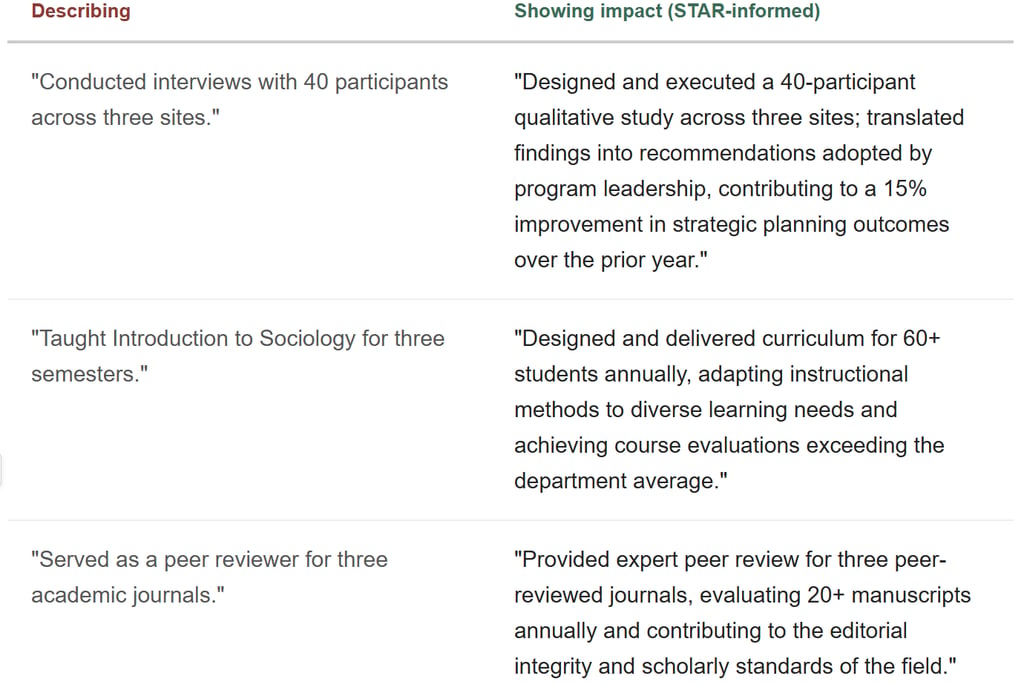
Same experiences. The result — or at minimum, the action taken toward a result — is now part of the story.
Three Steps to Make Your Experience More Explicit
1. Ask "so what?" after every bullet point. If your resume line describes an activity, push one step further. What did it produce? What did it enable? What changed because of it? That answer belongs in your resume. And here's the thing — if you've spent any time in academia, you already know this move. Every strong research argument has to answer the same question: why does this matter? Your resume is asking you to do exactly that, just for a different audience.
2. Name the transferable skill explicitly. Don't assume the reader will connect "designed a graduate seminar" to "curriculum development and instructional design." Say it. Academic readers infer; non-academic hiring managers need the bridge built for them.
3. Use the job posting as your guide. Look at the language the employer uses to describe what they need. Where your experience genuinely maps onto those needs, mirror their words. It makes it easier for them to make the connection — you want to take as much work off of the hiring manager as possible.
Don't Worry about "Bragging"
If this feels uncomfortable, that's normal. Most PhDs I work with initially resist this kind of language because it feels like bragging or like distorting the truth. But there's nothing dishonest about making your work legible to a new audience.
And here's a reframe that might help: when you communicate your value clearly, you're not just advocating for yourself — you're also doing the employer a service. They're looking for the right person. The sooner they can see that you might be that person, the closer they are to ending their search and welcoming a strong new addition to their team. Clarity on your end makes their job easier. T
You've done this before — every time you explained your research to a non-specialist, wrote for a public audience, or taught a room full of students who didn't share your expertise. This is the same skill, applied to your own story.
© 2026 Marya T. Mtshali. All rights reserved. No part of this publication may be reproduced, distributed, or transmitted in any form or by any means without prior written permission from the author.
What is your post-PhD career persona?
Are you a Strategist, Communicator, Analyst, or Builder? Take my free, quick quiz to uncover your unique strengths and get the Post-PhD Starting Point workbook — featuring 30 transferable skills employers want right now.
Bonus: When you get the workbook, you’ll also get early access to the Scholarly Transitions newsletter, which includes:
• Practical job search and career transition tips for PhDs
• Academic and professional development insights
• Highlighted job postings ideal for PhDs exploring non-academic paths
Scholarly Transitions
Career Coaching for PhDs—Informed by Experience Across Industry, Nonprofit, and Higher Education
Stay in touch
scholarlytransitions@gmail.com
© 2026. All rights reserved.


Member of Career Counselors' Consortium Northeast